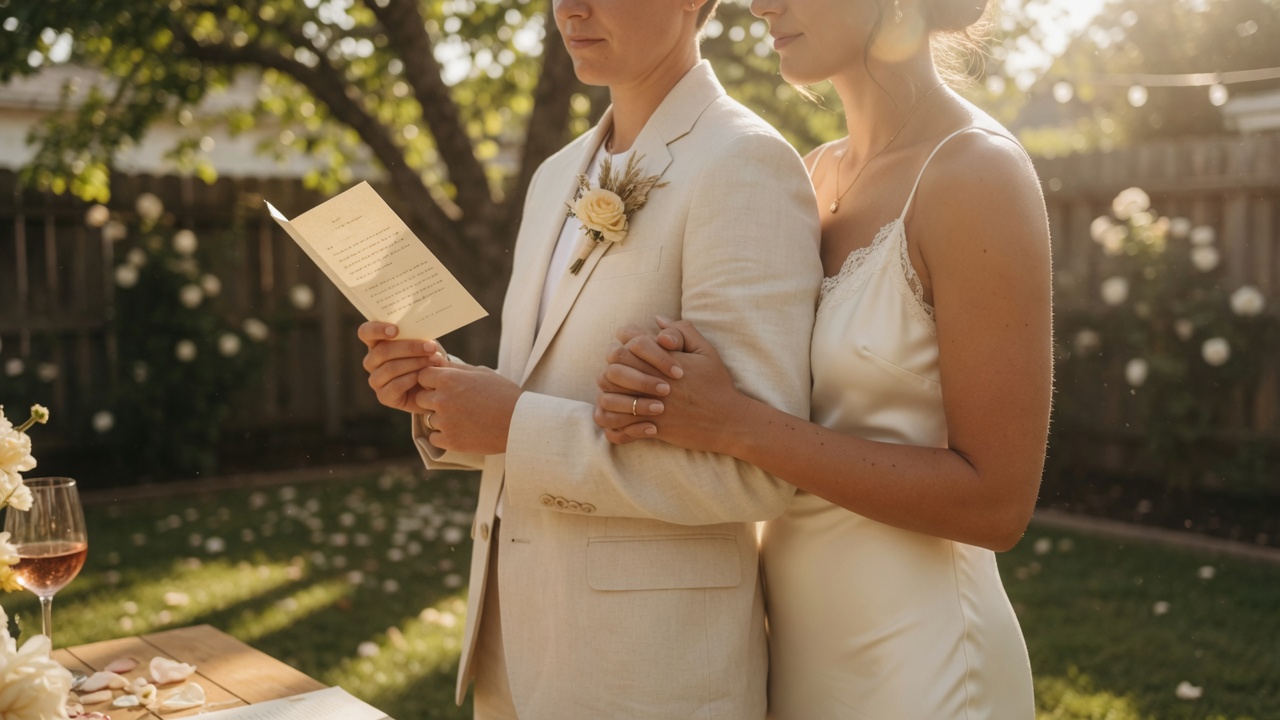
Custom wedding vows are not a speech contest and they are not a Mad Libs page you fill in ten minutes before the processional. They are promises written in your own voice — specific enough that your partner recognizes the life you already share, and clear enough that you can keep them on ordinary Tuesdays. Whether you start from a blank page or reshape a classic line, the point of custom wedding vows is the same: the room hears a ceremony, and your partner hears you.
This guide shows you how to write custom wedding vows without sounding generic, stiff, or copied. You will get a simple frame, examples you can adapt, and a few honest rules about what to leave out. If you want the broader process first, start with this guide to writing your own vows. If you already have the feelings and need help turning them into one-of-one language, pair this with personal wedding vows.
What Custom Wedding Vows Actually Are
Custom wedding vows are promises you write for this marriage, in this voice, for this person. They can be one minute or two. They can keep a traditional line if that line still sounds like you. What they cannot be is interchangeable. If you could swap the names and read the same paragraph at a stranger's wedding, you are not done yet.
That is the difference between "personal-sounding" and custom. Personal-sounding uses warm adjectives. Custom uses evidence: the way they settle a room, the night you both stayed, the Tuesday habit that makes you feel chosen. Guests will remember the feeling. Your partner will remember the detail only the two of you share.
You do not need to invent a brand-new form of marriage to write custom wedding vows. You need to tell the truth in language you would still stand behind next year. Specificity is the whole craft.
"I did not fall for the easiest version of you. I fell for the person who makes a regular evening feel like home, who tells the truth even when charm would be simpler, and who reaches for my hand in a crowded room. Today I vow to keep choosing this life with you — patiently, gratefully, and with my whole honest self."
How to Write Custom Wedding Vows From Real Life
Do not start with "I love you because you are kind." Start with a messy list. Give yourself twenty honest minutes and write four columns: how you met, how they show up when you are tired, what marriage means in ordinary weeks, and what you want to protect. Circle the lines that make your throat tighten. Those are your raw materials.
Then use a four-part frame and fill it with details only you would recognize. Open with who they are to you. Add one memory or quality that is not generic. Make two or three Tuesday-level promises. Close with a line that chooses them again. Read every sentence out loud. If it sounds like a greeting card, a toast, or a speech you would never give at dinner, rewrite it.
- One shared memory only the two of you would recognize
- One quality that is not generic "kind," "funny," or "beautiful"
- Two or three promises you can keep on a tired Tuesday
- A closing line that feels final when spoken slowly
"Before I promise you forever, I want to promise you the days in between. I will listen when I would rather be right, celebrate the work nobody else sees, and keep our friendship underneath the romance. You are my favorite person and my safest place, and I choose you again today."
Custom Vow Examples You Can Adapt
Use these as structure, not scripts. Keep the arc — notice, gratitude, promise, close — and replace every detail until nothing borrowed remains. A custom vow should fail the stranger test: nobody else could honestly say this paragraph about this person.
If you want a wider set of tones after you lock your own draft, browse wedding vow examples. Read them second, not first, so their phrasing does not colonize yours.
"I still think about the night we missed our turn and decided the long way home was better. That is the life I want with you — unhurried, honest, and slightly off the map. I promise to stay curious about you, to make our home a place of warmth, and to choose us when the day is ordinary and when it is hard. I am yours."
Notice what is missing: a biography of every year, a joke at their expense, and a promise so vague it could belong to anyone. Custom does not mean long. It means true.
Custom vs. Template vs. Traditional Vows
A template is a skeleton. Traditional wording is a shared language your guests already know. Custom wedding vows are the sentences only you can finish. Many strong ceremonies use all three: a required civil or religious formula, plus a short custom statement that sounds like the two of you.
If a blank page freezes you, start with ready-to-personalize vow templates and then overwrite every bracket until the line could not belong to another couple. If the official exchange already carries the legal or liturgical weight, compare it with classic ceremony vow wording and keep your custom piece shorter — one memory, two promises, one close.
The question is not "template or custom?" The question is "what still sounds like us after the required words are spoken?" Answer that, and the form becomes obvious.
What to Put In — and What to Leave Out
Put in one turning-point memory, one quality that is theirs alone, and promises about listening, partnership, and everyday care. A single sentence about the future you want — a quieter home, a louder one, children, travel, a life close to family — is enough. You do not need to narrate every season you have already lived.
Leave out three common traps: writing to educate the room, roasting them in front of both families, and making promises so huge they collapse by Thursday. Replace "I will always love you" with something they can feel next month. Custom wedding vows succeed when they name the life you are actually offering, not the life a movie would score with strings.
Short Custom Vows vs. Longer Story Vows
Short custom vows still need a clear promise. Aim for under a minute when nerves are high; one sincere memory and two clean promises can outperform a page of purple prose. Speak slowly so brief lines can land. If you want compact samples after you draft your core, see short wedding vows.
Longer story vows usually sit between one and two minutes. That is enough room for a scene, a few promises, and a close — not enough room for a speech about every year. Agree on a range with your partner so both readings feel balanced. Custom does not require length. It requires that every line earns its place.
Matching Tone With Your Partner
You do not need matching jokes or matching word counts. You do need a shared sense of the moment. If one of you writes a two-minute letter and the other writes four sincere lines, the ceremony can feel lopsided even when both vows are beautiful. Decide together: romantic, lightly funny, faith-forward, or quiet. Then draft separately so the words stay yours.
Compare length and tone once — not line by line. The strongest pair of custom wedding vows feels like two people, not one speech in two voices. If humor is part of how you love each other, keep it affectionate and let the last two sentences carry the weight.
The Final Edit Before You Say Them
The last pass is simple: cut anything that does not sound like you when read aloud. Keep habits, nicknames used sparingly, and ordinary-day promises. Drop elevated vocabulary you would never use at home. If a metaphor needs explanation, delete it.
Ask one trusted person who knows the relationship to listen once — not a committee. Then stop editing two days before the ceremony so the words settle. Print a backup card. Mark pauses. Custom wedding vows succeed when your partner hears your real voice. Specificity, sincerity, and a few promises you intend to keep will always outrank a performance.
Frequently Asked Questions
What are custom wedding vows?
Custom wedding vows are promises you write in your own words for your partner and this marriage. They can stand alone or sit beside a traditional or legal formula. The test is simple: if you could swap the names and read the same lines at another wedding, they are not custom yet.
How do I write custom wedding vows if I am not a writer?
Start with lists, not poetry. Write how you met, how they show up when you are tired, and what you want to protect. Then use a short frame: who they are to you, one specific memory, two or three promises you can keep, and a closing line that chooses them again. Read the draft out loud and cut anything that sounds borrowed.
How long should custom wedding vows be?
Most couples do well between one and two minutes when read slowly, roughly 100 to 200 words. Shorter is fine if every line earns its place. Agree on a range with your partner so both readings feel balanced, especially if the ceremony already includes long readings.
Can custom wedding vows still include traditional lines?
Yes. Many couples keep a classic exchange for the official moment and add a short custom statement before or after. You can also weave one traditional phrase into otherwise original wording if it still sounds like you. Confirm any required formula with your officiant before you draft.