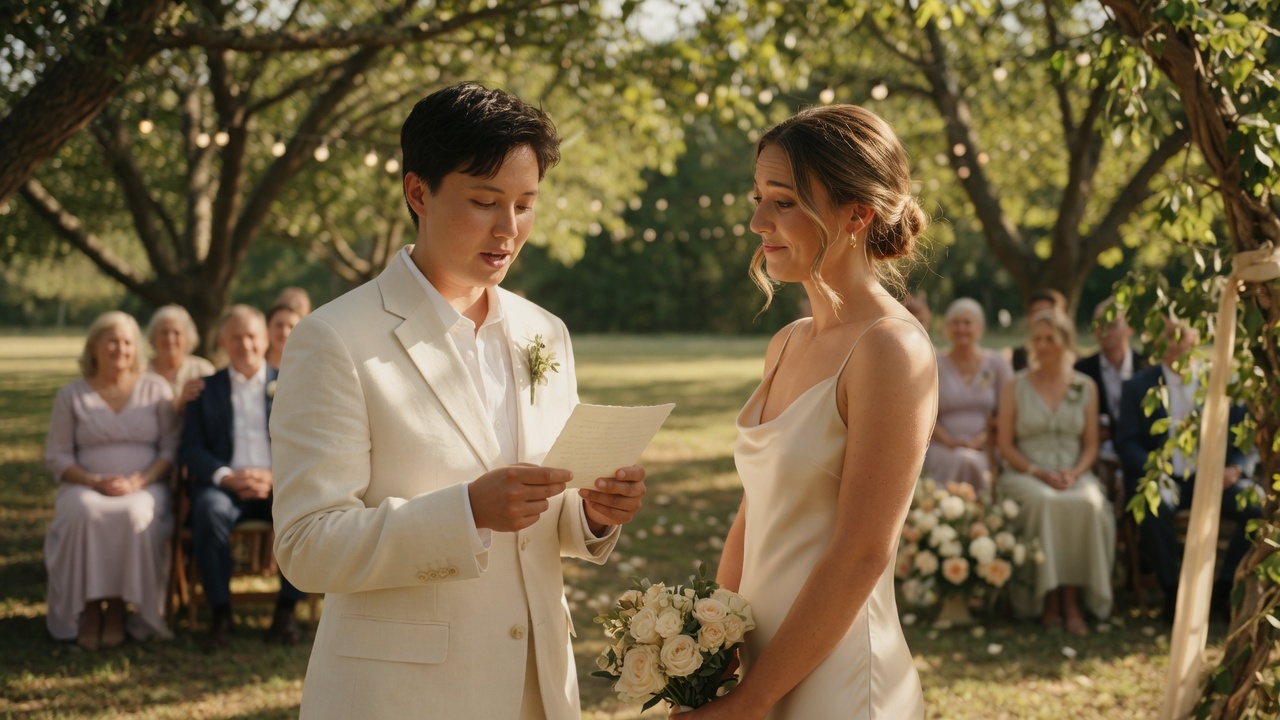
Humorous wedding vows work when the room smiles and your partner still hears a real promise underneath the wit. Guests remember the line. Your person remembers that you chose them on purpose. The goal is not a set at the altar. It is a vow that sounds like the two of you on a good day: dry, warm, and unmistakably committed.
This guide is for couples who already speak in understatement and do not want a solemn script that sounds borrowed. You will get the line between wit and roast, partner-safe rules, examples you can steal the rhythm from, and a writing frame that keeps the last sentences sincere. If you want the broader humor craft first, start with playful ceremony wording. For the drafting process itself, pair this with our step-by-step vow writing guide.
What Humorous Wedding Vows Actually Sound Like
Humorous wedding vows sound like an inside observation the whole room is briefly allowed to overhear — then they turn into a promise. The smile comes from a true, small detail: the way they narrate the dog, the way they pack for a two-day trip as if winter is coming, the way they "help" by adding eight snacks to a two-item grocery run. The landing comes from a line that would still work if every joke were cut.
If the humor could be swapped onto a stranger and still get a laugh, it is a toast. If only your partner would recognize the detail, it is a vow. That is the whole difference. Wit is a seasoning. The meal is still the marriage.
"I vow to keep pretending your 'quick stop' is ever actually quick, to share the last dumpling even when I have already claimed it in my heart, and to never use the phrase we need to talk unless I am also holding snacks. Under all of that, here is the truth: you are my favorite person and my safest place, and I choose this life with you."
Humorous vs. Funny vs. Hilarious
Funny vows smile. Hilarious vows make the room actually break. Humorous wedding vows sit in the middle: dry enough that the laugh is a knowing one, warm enough that nobody wonders whether you meant it. You are not chasing a roar. You are letting the room see how you actually talk to each other.
Use that difference on purpose. If you want bigger laughs and a sharper comic arc, read hilarious wedding vows second — after your own draft exists — so their punchlines do not colonize yours. Humorous is understatement with a sincere close. Hilarious is a bigger swing. Both fail the same way: when the last two sentences sound like an encore instead of a wedding.
Partner-Safe Rules Before You Write a Joke
Partner-safe is the only rule that matters. No exes, no private fights, no money, no in-laws who did not sign up to be material, no bodily humiliation, and nothing that needs a three-minute backstory to land. If a trusted friend who knows you both would wince, cut it. Ceremony humor should reduce nerves, not create a second performance to manage.
Agree on tone before you draft. One of you can lean witty while the other stays quietly romantic, as long as the lengths feel balanced and nobody is ambushed. Read the draft out loud once. Comedy that only works on the page will freeze you at the altar.
- One true, specific habit — not a generic "you are messy" joke
- One smile the whole room can share without a footnote
- A closing promise that would still stand if the jokes were removed
Humorous Wedding Vow Examples to Steal the Rhythm From
Steal the arc, not the details. Notice, tease, promise, close. Replace every habit until nobody else could honestly say this paragraph about this person. If you want a wider set of tones after you lock your own draft, browse real vow samples for inspiration — read them second so their phrasing does not colonize yours.
"I take you with your competitive board-game face, your talent for losing the remote in a one-room apartment, and your belief that leftovers become a new cuisine on day four. I also take you as my partner for real: I will listen when I would rather be funny, show up when the day is ordinary, and love you on purpose for the rest of our days."
Notice what is missing: a biography of every year, a joke that needs explaining, and a promise so huge it collapses by Thursday. Humorous does not mean long. It means true, then kind.
How to Write Humorous Vows Without Sounding Like a Roast
Do not start with a punchline. Start with a messy list. Give yourself twenty honest minutes and write four columns: how you met, the habit that makes you smile, how they show up when you are tired, and what you want to protect. Circle the lines that make you grin and then go quiet. Those are your raw materials. Poetry, if you want it, comes later.
Then use a four-part frame. Open with who they are to you. Add one humorous-because-it-is-true detail. Make two Tuesday-level promises. Close with a line that chooses them again. Read every sentence out loud. If a joke needs your face to stay kind, rewrite it until the words themselves are kind. Specificity is the whole craft. "I promise to always let you pick the show — even the one we have already finished twice" beats abstract comedy every time.
- Open warm, not with a roast
- One inside detail the room can still follow
- Two promises you can keep on a tired Tuesday
- A last sentence you can say slowly while looking up
If a blank page freezes you, start from a simple frame and overwrite every line until the joke and the promise could not belong to another couple. If the humor is really just a doorway into your story, push the details further with custom personal vows. Then stop adding punchlines. The second witty beat is usually enough. The third is almost always a toast in disguise.
"I did not fall for a highlight reel. I fell for the person who narrates the GPS even when it is already talking, who makes a regular Tuesday feel like the point, and who reaches for my hand in a crowded room. I promise to listen when I would rather be funny, to celebrate the work nobody else sees, and to keep choosing this life with you — patiently, and with my whole honest self."
Short Humorous Vows That Still Land
Brevity is not a loophole. A short vow can still sound like a toast if every line is a punchline. Compact humorous wedding vows do one job well: one true habit, two keepable promises, one close. Aim for under a minute when read slowly. Cut adjectives first. Keep the evidence.
"You are my favorite person and my safest place — even when you insist the leftovers are 'still good.' I vow to love you with patience, humor, and the same attention I give the small days. I choose you."
If the ceremony is tight, or you hate public speaking, that length is enough. For pacing and more compact shapes, look at brief vow examples, then keep one living detail so the short version still fails the stranger test. Practice once standing up. A short vow rushed will feel thinner than it is. A short vow spoken like you mean it can land harder than a page of bits.
When Humorous Vows Are the Wrong Call
Skip the wit if either of you freezes in public, if family culture expects formal language only, or if your officiant has tight timing and a solemn tone. Humor should reduce nerves, not create a second performance to manage. When in doubt, write a sincere draft first, then add one light line you both approve.
A huge mismatch — a string of jokes next to a quiet paragraph — can make the ceremony feel uneven even when both vows are loving. Decide the range together. Humorous wedding vows succeed when the smile is real and the promise is louder.
Frequently Asked Questions
Are humorous wedding vows appropriate for a formal ceremony?
They can be, if the humor is gentle, partner-safe, and the last lines are sincere. Agree with your partner and officiant first. One well-placed smile in a formal room lands better than a string of punchlines.
How many jokes should I put in humorous wedding vows?
One or two. After the second laugh, guests start waiting for the next joke instead of hearing the promise. Always end on a line that would still work if every joke were removed.
What is the difference between humorous and funny wedding vows?
Funny vows play for a clear laugh. Humorous vows often sit closer to dry wit and understatement — a knowing smile rather than a roar. Both still need a sincere close. If you are chasing bigger laughs, write the promise first, then add one true, partner-safe beat.
Should both partners write humorous vows?
Not necessarily. One of you can lean witty while the other stays romantic, as long as you agree on tone and length. A huge mismatch — a comedy set next to a solemn paragraph — can feel uneven even when both vows are loving.
How long should humorous wedding vows be?
Most couples do well between one and two minutes when read slowly. Humorous vows do not need extra length for extra jokes. Agree on a range with your partner so both readings feel balanced.
Can I use sarcasm in wedding vows?
Only if the words stay kind without your facial expression to rescue them. Sarcasm that scores a point off your partner will read as a roast on the recording. Translate the joke into an affectionate observation, then close on a promise you can keep on a tired Tuesday.