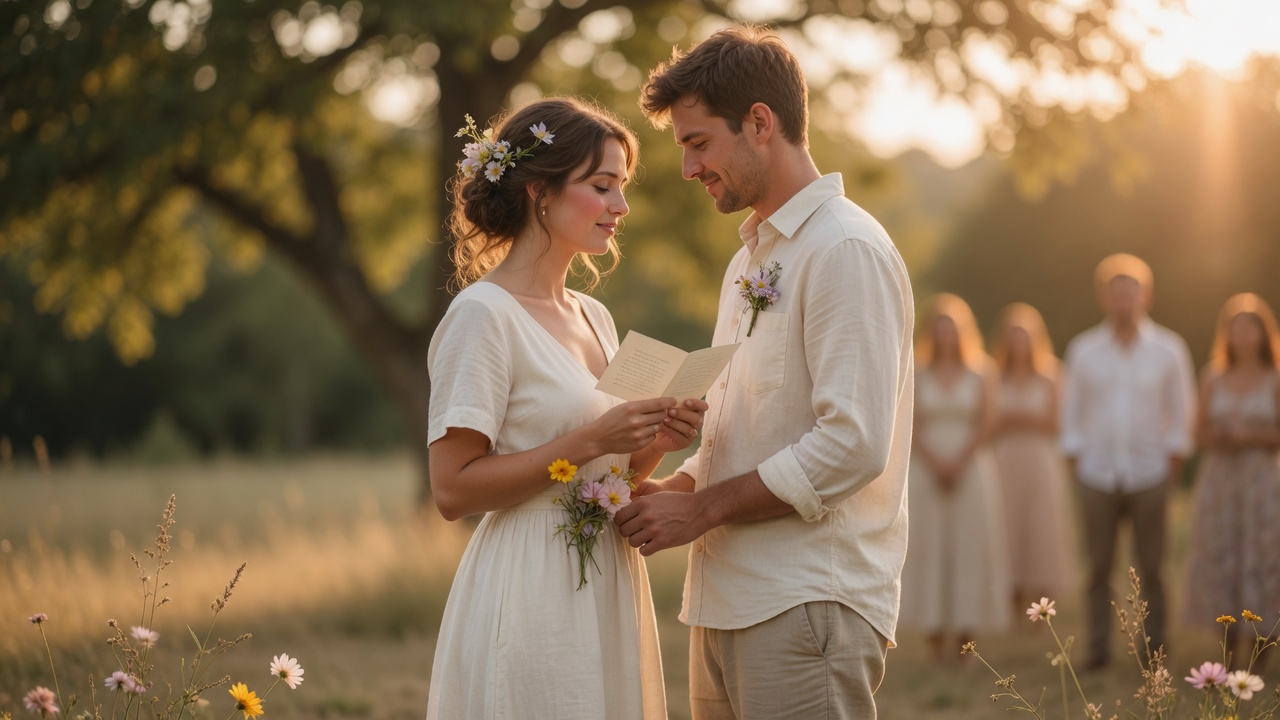
Short simple wedding vows for introverts are not a consolation prize. They are a complete promise you can finish while looking at one person — not a performance for a row of chairs. If public speaking makes your chest tight, a long speech is the wrong assignment. A few keepable sentences on a small card is the right one.
This guide is for the couple who would rather skip the microphone. You will get a length that is kind to a quiet voice, a four-line frame that fits on a card, and examples you can steal the shape from — never the details. For a wider set of brief samples after you lock the idea, start with brief vow examples.
Why Short Simple Vows Suit Introverts
Introverts do not fail at vows. They fail at being asked to entertain. A ceremony can feel like a spotlight even when the words are true. Short simple wedding vows for introverts cut the job down to what actually matters: one person, a few keepable lines, and a close you can say before your voice thins out.
Guests do not need a novel. They need to witness a decision. Your partner does not need poetry. They need a promise they can remember on a tired Tuesday. Brevity is not less love. It is less theater.
"I am not here to give a speech. I am here to choose you. I vow to listen when I would rather hide, to tell you the truth even when it is small, and to keep making a quiet life with you on purpose."
Notice the temperature. No biography of every year. No joke that needs a setup. No metaphor that has to be explained. If a line would embarrass you at the dinner table, it does not belong on the card.
You Do Not Owe the Room a Speech
The room is not the audience. Your partner is. Write as if you are speaking across a kitchen table after the guests have gone. If you would never say "my beloved" at dinner, do not say it at the altar unless that is truly your voice.
You can also split the work. A short public line plus a longer private exchange — before the ceremony, at a first look, or later the same day — is a real option, not a workaround. If that split would let you breathe, read private wedding vows after you have a public card you can finish.
How Short Is Kind
For most introverts, thirty to sixty seconds is the kind range — roughly 40 to 100 words, read slowly. Under twenty seconds can feel unfinished unless the rest of the ceremony already carries the legal and traditional weight. Over ninety seconds is where many quiet voices start to rush.
Agree on a similar spoken length with your partner so one reading does not accidentally become a speech next to a postcard. Ask the officiant what is required versus optional. Then write a 45-second draft and a 70-second backup, and cut adjectives first. Keep the promises.
"You are my safest ordinary day. I promise to come home to you, to be kind when I am tired, and to keep choosing this life we are already building. That is the whole vow."
A Small-Card Frame for Quiet Voices
Do not open a blank document and wait for a paragraph. Open notes and give yourself fifteen honest minutes. Write four ugly lists: how they show up when you are tired, a habit only the two of you would recognize, what you want to protect in ordinary weeks, and one promise you can keep when you would rather go quiet. Circle three lines that make your throat tighten. Those are the raw materials. Anything you wrote to sound impressive can wait in the margins and then be deleted.
Then use a four-line frame that fits on a small card. Line one: who they are to you, in a sentence you would actually say. Line two: one specific detail the room can follow without a footnote. Line three: two Tuesday-level promises. Line four: a close you can say slowly while looking up. Read every sentence out loud once, standing up. If you run out of air, the sentence is too long. Break it.
- One true detail only they would recognize
- Two promises you can keep when you are tired
- No metaphor that needs explaining
- A last sentence that still works if every extra word is cut
If a blank page still freezes you, start from our step-by-step vow writing guide and overwrite until the draft sounds like a letter, not a template. If you need slots to drop real details into, use fill-in-the-blank vow outlines — then delete anything that could belong to another couple.
"You make a regular evening feel like home. I vow to keep our friendship under the romance, to listen before I defend, and to love you in the ways that show up on Tuesdays — not only on the days that look like a photograph."
Print the card in a size you can hold without hiding your face. Mark one pause before the last line. Stop rewriting two days before the ceremony so the words can settle. A quiet voice does not need more adjectives. It needs a sentence it can finish.
Where to Borrow Structure Without Performing
Structure is allowed. A performance is not required. Borrow an order of operations from custom personal vows — who they are, one memory, two keepable promises, a close — then overwrite every fact until the page fails the stranger test. If you could swap the names and still sound impressive, it is not yours yet.
Ask one trusted person who knows the relationship to listen once. Not a committee. Then stop. Extra opinions will push you toward a speech you never wanted to give.
Short Simple Vow Examples for Introverts
Steal the arc, not the life. Notice, promise, close. Replace every habit until nobody else could honestly say this paragraph about this person. Keep the understatement. Change the facts. If you want a wider set of tones after you lock your own draft, browse real vow samples for inspiration second, not first, so their phrasing does not colonize yours.
"I choose you without a script bigger than this: I will be patient when I am overwhelmed, honest when it would be easier to go quiet, and loyal in the small rooms as much as the bright ones. You are my person. I am yours."
That is enough. A short simple vow for an introvert is not a lesser vow. It is a keepable one, said on purpose, without a show.
Frequently Asked Questions
Are short simple wedding vows for introverts less meaningful?
No. Meaning comes from a keepable promise and one true detail, not from how long you can hold the room. A thirty-second vow that sounds like you will land harder than a four-minute speech you cannot finish. Guests hear a ceremony. Your partner hears you.
How long should wedding vows be if I hate public speaking?
Most introverts do well between thirty and sixty seconds when read slowly, roughly 40 to 100 words. Agree on a similar range with your partner so both readings feel balanced. Ask your officiant what is required so you do not write longer than the ceremony needs.
Can we do private vows and keep the public part very short?
Yes. Many couples exchange a longer private vow before the ceremony or at a first look, then say a few public lines for guests. Confirm the plan with your officiant so the public portion still includes any required legal language.
What should I put on a small vow card?
Four parts: who they are to you, one specific detail only you would recognize, two Tuesday-level promises, and a close you can say while looking up. Print it large enough to read without hiding your face. Mark one pause before the last line.
How do I keep short introvert vows from sounding generic?
Use evidence, not adjectives. One habit, one quality that is not generic kind or funny, and two promises you can keep when you are tired will outperform a stack of forever lines. Read the draft out loud and cut anything you would never say at dinner.
Should both partners write vows the same length if one is more outgoing?
Matching eloquence is not required. Matching spoken time is kinder. Let the outgoing partner cut toward your length, or keep yours short and sincere while they write a little longer — then ask them to land closer to a minute so the ceremony does not tilt.