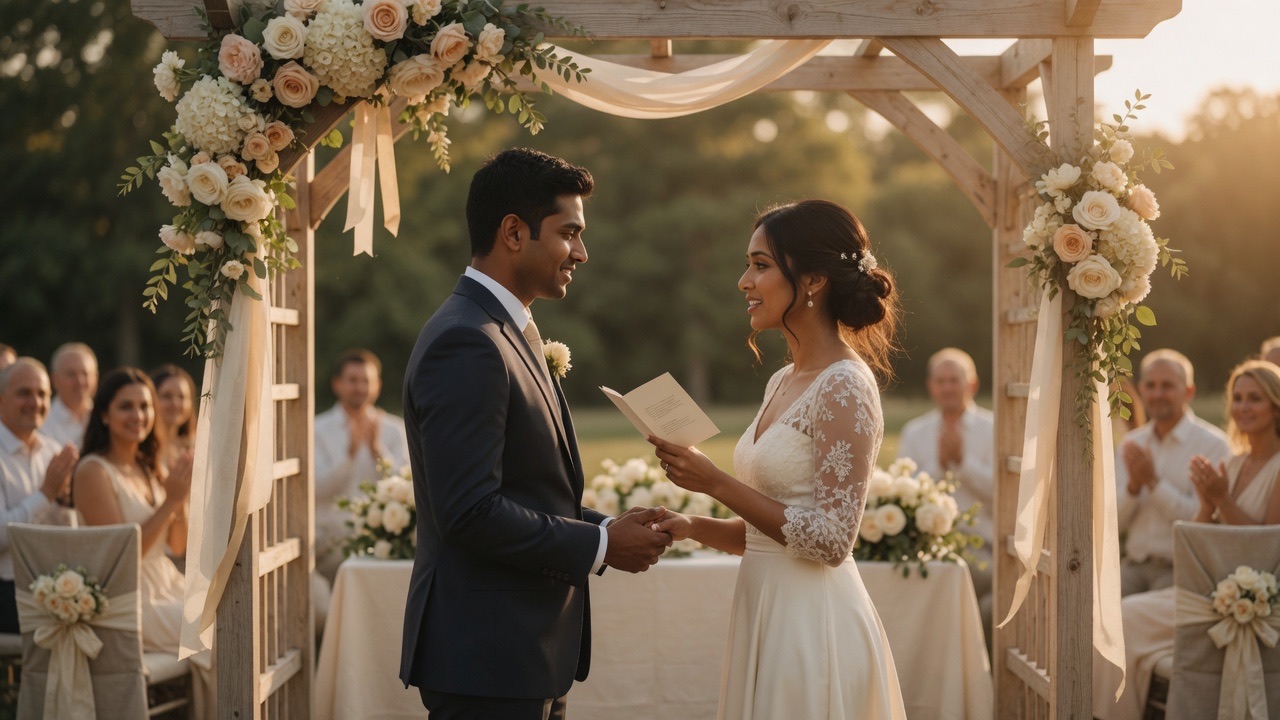
Wedding vows to say to each other are not a speech for the lawn. They are two people looking at one person — naming a promise out loud while everyone else happens to overhear. The strongest versions sound like you on an ordinary Tuesday, not like a greeting card performing for cousins.
This guide is about the mutual exchange: how to write lines you can actually speak, whether your vows should match, who goes first, and how to keep the moment between you instead of broadcasting at the room. If you still need a full drafting process, start with our step-by-step vow writing guide, then come back here to shape what you will say face to face.
What Wedding Vows to Say to Each Other Are For
Wedding vows to say to each other exist to make a choice audible. Guests hear a ceremony. Your partner hears a promise they can remember on a hard Tuesday. That is a different job than a toast, a timeline of your relationship, or a performance that needs applause.
Hold two things at once: the intimacy of talking to one person, and the public fact that other people are listening. Clarity wins. Use "you." Name one memory only the two of you would recognize. Make two or three promises you can keep when you are tired. Close by choosing them again, in a sentence you could still mean in ten years.
"I am not making this promise to the room. I am making it to you. I vow to listen when I would rather be right, to stay when a day is ordinary, and to keep building a life that feels like home with you."
If a line could be said to anyone, it is not finished. Specificity is what makes wedding vows to say to each other feel mutual — even when the wording is not identical. For more hyper-specific storytelling, borrow structure from custom personal vows, then overwrite every borrowed image until nobody else could honestly say the paragraph.
Speak to One Person, Not the Room
A common mistake is writing for the congregation. Sermon cadence, a biography of every year, a joke that needs both families to laugh — those lines perform. They do not land on the person in front of you. Look at them. Start with who they are, not how impressive you sound.
If a metaphor needs explaining, cut it. If a nickname only six people understand, cut it or save it for later. If a sentence would never come out of your mouth at the kitchen table, rewrite it until it would. Your partner already knows whether you mean it. The room does not need to be impressed.
Delivery helps the same goal. The pillar guide on how to say your wedding vows covers pace, cards, and what to do if you cry. Use that for the body of the moment. Use this page for the relationship inside the words: you are talking to each other, not presenting a brand of love.
Matching Vows or Two Different Speeches
Your vows do not have to match. They have to sit in the same room without one of you giving a novel and the other giving a caption. Agree on length, tone, and whether humor is welcome. Then write separately so neither draft colonizes the other.
Some couples want a shared closing line. That can be beautiful if it is short and true — one sentence you both say, or a promise you wrote together and each speak in your own voice. Identical paragraphs, read back to back, often feel like a script. Parallel promises — same length, different details — usually feel more like a marriage.
If you want models for length and style before you draft, browse real vow samples for inspiration. Steal the arc, never the biography. Then compare drafts once, not ten times, so you are coordinating, not editing each other into sameness.
Who Goes First, and How to Take Turns
Ask your officiant what the ceremony already assumes. Many couples let the person who is more nervous go second, so they have a moment to settle. Others prefer the traditional order their families expect. There is no moral prize either way. Decide before the rehearsal so the pause between you is planned, not awkward.
- Agree who starts, and tell the officiant in one sentence.
- Face each other, not the guests, unless your venue or faith tradition requires otherwise.
- Leave a breath after the first vow before the second begins — do not rush to "match energy."
- If you are exchanging rings in the same beat, keep the spoken promise finished before you fumble with the band.
Turn-taking is part of the vow. Listening is visible. When it is not your turn, look at your partner, not at your card. Guests will photograph that more than a perfect sentence.
Keep Length and Tone in the Same Room
Aim for a similar spoken length — often about one to two minutes each, read slowly. If one of you is a writer and the other is not, the shorter vow is not the lesser one. Cut the longer draft. Do not pad the shorter one with adjectives.
Tone should be compatible, not cloned. One playful line is fine if the last sentences are sincere. A roast that needs a victim is not. If you get emotional easily, brief vow examples are easier to recover mid-sentence, and they still count as a full promise.
Mutual Vow Examples You Can Adapt
Steal the shape, not the life. Notice, thank, promise, close. Replace every habit until the paragraph could only belong to you. These samples are written as wedding vows to say to each other — second person, present tense, short enough to speak without gasping.
"You are my favorite person and my safest place. I promise to choose you on ordinary Tuesdays, to tell you the truth even when it is small, and to keep making a home where we both get to be fully ourselves. I am yours."
Notice what is missing: a resume of every year, a joke that needs a victim, and a promise so huge it collapses by Thursday. Mutual vows do not need extra length to prove devotion. They need two or three verbs the other person can trust when the house is loud.
If your draft still sounds like it could belong to any couple, add one living detail — the way they make a room feel, a hard season you already survived, a habit you actually want to keep. Then freeze the wording. Practice is for saying it, not for reinventing it the night before.
How to Say Them So You Still See Each Other
Print large type. Hold the card at chest height. Look down to find the next sentence, then look up for the promise. You do not need to memorize the whole page. You need a few clear moments of eye contact so it does not feel like a reading to the flowers.
Most people speak faster than they think they do. Leave a half-second of air after each sentence. If you cry, pause, breathe, and continue from the next full sentence — not from the half-word that broke. If you freeze, the card is not a failure. It is the plan.
"Today I look at you and I choose this life. I vow to be patient when I am tired, grateful when we are ordinary, and brave enough to keep talking when it would be easier to go quiet."
End on the line you mean most, even if you skip a middle detail. Wedding vows to say to each other work when the last thing your partner hears is a clear choice, spoken at a human pace.
Frequently Asked Questions
Do wedding vows to say to each other have to match?
No. They should be compatible in length and tone, not identical in wording. Agree on a similar spoken time and whether humor is welcome, then write separately so each vow still sounds like the person speaking. A shared closing line can work if it is short and true.
Who should say their wedding vows first?
Either partner can go first. Many couples let the more nervous speaker go second so they have a moment to settle. Ask your officiant what the ceremony already assumes, then decide before the rehearsal so the pause between you is planned.
How long should vows you say to each other be?
About one to two minutes each, read slowly, is a comfortable range for most ceremonies. Shorter is better than rushing a long draft. Match your partner's length so one reading does not accidentally overshadow the other.
Can we say private vows and public vows?
Yes. Some couples exchange a longer, more personal version privately and keep a shorter promise for the ceremony. Tell your officiant the plan so the public exchange still has a clear beginning and end. Keep the public lines specific enough that they do not feel like a placeholder.
What if I get emotional while saying vows to my partner?
Pause, breathe, and continue from the next full sentence. Crying is common and usually lands as sincere. Have large-print text ready so you can find your place without starting over. Do not apologize at length — a look and the next promise is enough.