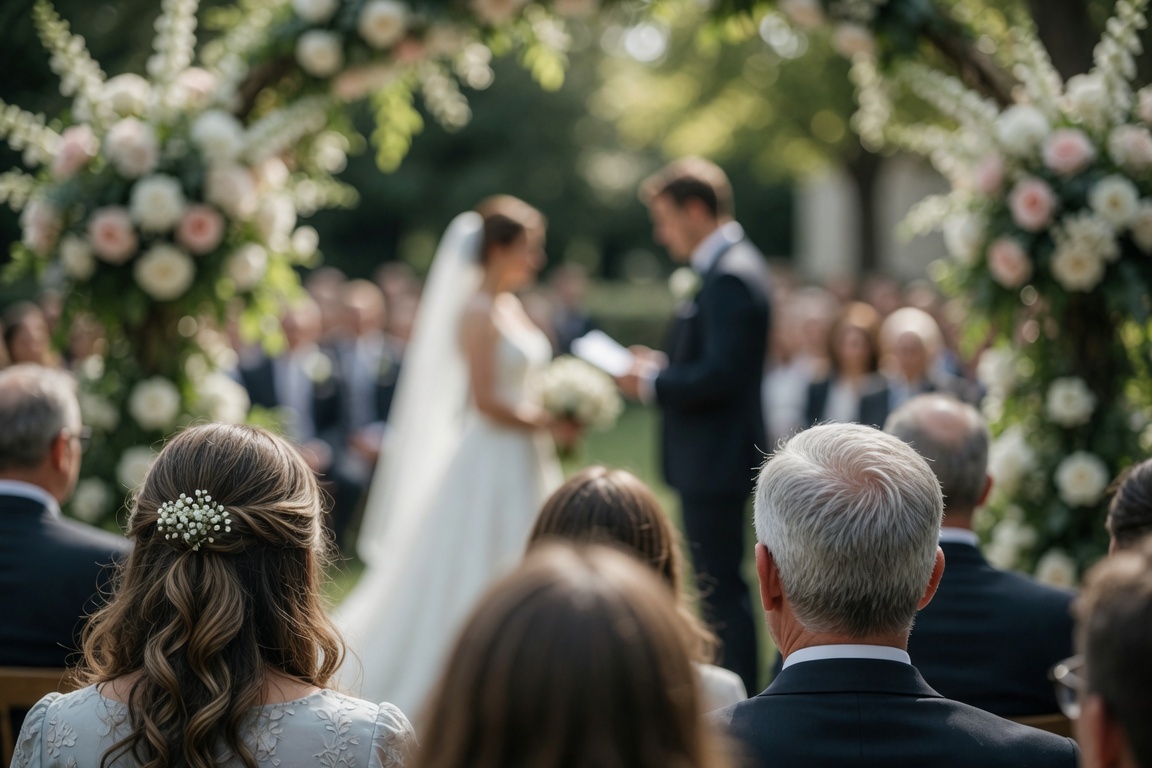
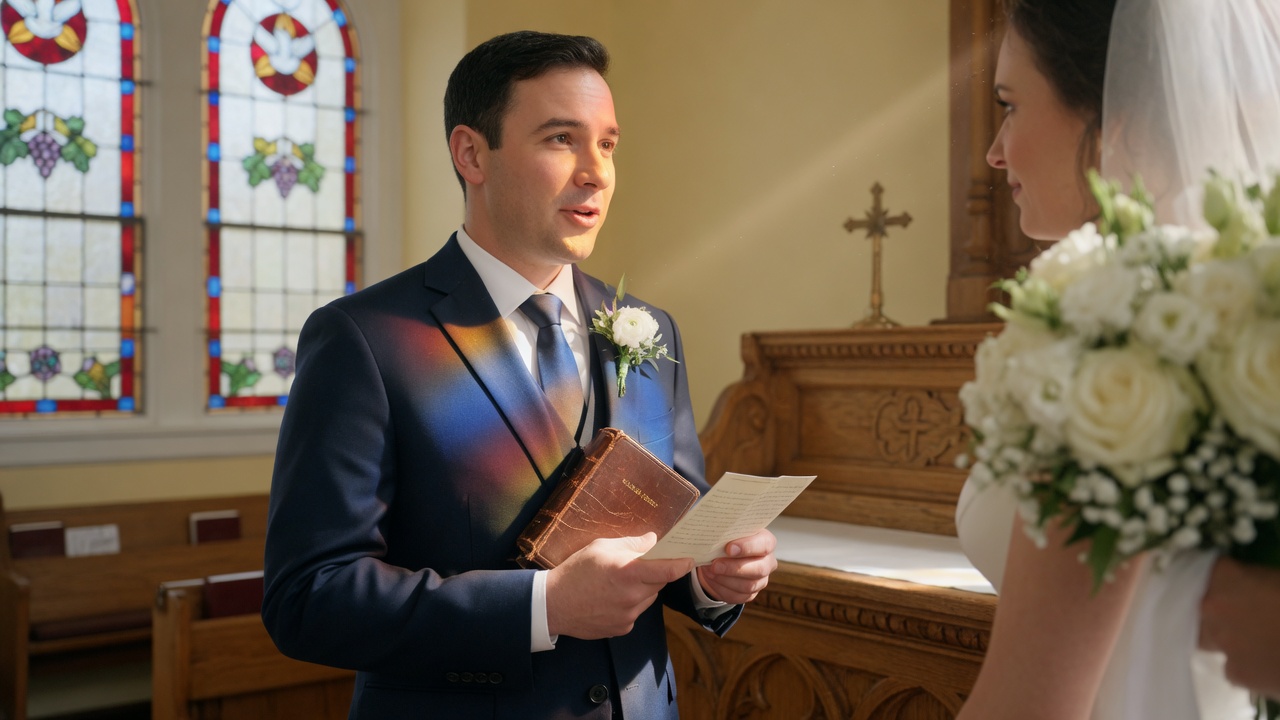
Christian vows to wife are not a speech about marriage in general. They are a man standing in front of God, his community, and the woman he is promising — and speaking to her. The strongest versions sound like him: clear, steady, and specific enough that she recognizes the life you already share, while still naming the faith that will hold you when feelings run thin.
This guide is written from a husband's mouth. You will find how to address her without preaching at the room, a simple frame for Christ-centered promises, and examples you can adapt rather than recite. For the wider church-ceremony picture, start with Christ-centered ceremony vows, then come back here for language that belongs in a vow spoken to her.
What Christian Vows to Your Wife Are For
Christian vows to wife exist to make a covenant audible. You are not auditioning for poetry, and you are not giving a toast. You are telling her — in public — what you intend to do with the years, under God. Guests overhear a marriage. She hears a promise she can remember on a hard Tuesday.
Hold two truths at once: deep love for her, and humble dependence on grace when love alone is not enough. Strength here is clarity, not volume. Name God as witness. Name her as the person you choose. Then keep the verbs small enough to live: listen, stay, pray, forgive, show up.
"Before God and these witnesses, I speak this to you. You are the wife I choose, not the life I stumbled into. I vow to love you as Christ loves the church — patiently, without keeping score, and with a loyalty that does not depend on an easy day."
If a line could be said to any bride in any church, it is not finished. Christian vows to wife work when she can hear her own life inside them.
Speak to Her, Not to the Room
A common mistake is writing for the congregation. Sermon cadence, a list of verses, a biography of every year — those lines perform. They do not land on her. Look at her. Use "you." Keep the first sentence about who she is, not about how spiritual you sound.
If a joke needs both families to laugh, cut it. If a metaphor needs explaining, cut it. If a faith phrase would never come out of your mouth at the kitchen table, rewrite it until it would. She already knows whether you mean it. The room does not need to be impressed.
A Simple Frame for Husband-to-Wife Promises
Write before you polish. Give yourself twenty honest minutes and four lists: how she loves people, how she has changed you, how she walks with God, and what you want your home to feel like. Circle the lines that make you go quiet. Those are the raw materials. Anything you wrote to sound like a husband in a movie can wait in the margins and then be deleted.
Then use a five-part frame. Thank God for her in one sentence that only your story holds. Name one specific way you have seen grace in her. Make two or three Tuesday-level promises you can keep with His help. Close by choosing her again in Christ. If you still need a path from blank page to ceremony, pair this faith focus with our step-by-step vow writing guide so the spiritual heart has a clear arc.
- One gratitude to God that only your marriage holds
- One quality in her that is not generic "kind" or "beautiful"
- Two or three promises you can keep when you are tired
- A closing line that chooses her again, clearly, in Christ
Read every sentence out loud. If it sounds like a greeting card or a seminary paper, rewrite it. One living detail — the way she prays before hard days, the quiet way she serves your family — will do more work than a paragraph of churchy phrases you would never say again.
Traditional Christian Vows Spoken to a Wife
Many churches still use classic Christian vow forms that echo centuries of liturgy. Those lines are familiar, weighty, and easy for guests to recognize. They also leave room — depending on your denomination — for a shorter personal statement before or after the formal exchange.
The traditional heart is simple: "I take you to be my wife," then the conditions of a life, then God as witness. Catholic and some liturgical traditions keep the sacramental formula fixed; personal lines may be a reflection, not a replacement. If you love ceremonial language, compare this with traditional wedding vows, then confirm the exact required text with your pastor or priest so you write once with confidence.
You can keep the required formula and still add a short, spoken promise to her in your own words. Sacred does not require long. It requires that she hears you mean it.
How to Weave Scripture Without Preaching at Her
Scripture deepens Christian vows to wife when you choose one living passage and explain why it belongs to your story. A short phrase woven into a promise usually feels warmer than a list of citations. Beloved options include 1 Corinthians 13, Ruth 1:16–17, Ecclesiastes 4:9–12, Ephesians 5, and Colossians 3:12–14. Match the verse to your real marriage, not to Pinterest popularity.
Quote only a brief line, then say what it means in your home. Prefer a translation your congregation already knows. Let the verse support a promise, not replace one. "A cord of three strands is not quickly broken" is enough — then tell her you will not try to be her savior, you will walk beside her toward the One who already is. For more verse-first wording, see our guide to biblical vows.
If the faith is real, name God or Jesus honestly. One living mention of covenant or grace lands better than a paragraph of phrases you will never say again.
Christian Vow Examples You Can Speak to Your Wife
Steal the arc, not the details. Notice, thank God, promise, close. Replace every habit until nobody else could honestly say this paragraph about this woman. These samples are written from a husband's perspective to his wife. Keep the understatement. Change the life.
"I thank God for you. In you I have seen grace I did not know how to name — the way you pray when I am stubborn, the way you make a room feel like home. Today I promise to listen when I would rather be right, to seek forgiveness quickly, and to build a house where Jesus is spoken of with joy. I am yours, in covenant, for as long as we live."
Notice what is missing: a resume of every year, a joke that needs a victim, and a promise so huge it collapses by Thursday. Christian vows to wife do not need extra length to prove devotion. They need two or three verbs she can trust when the house is loud.
If you want a wider groom-focused set after you lock the spiritual core, browse groom vow ideas — read them second so their phrasing does not colonize yours. Then overwrite every borrowed image until the line could not belong to another couple.
What to Leave Out When You Address Her
Leave out the roast. Leave out inside jokes that only six people understand. Leave out a lecture on Ephesians that belongs in a homily, not in a vow. Leave out any mention of a former relationship, even as contrast. Leave out promises you cannot keep on a tired weeknight — "I will never fail you" is not a vow, it is a setup.
Cut movie quotes, elevated vocabulary you would never use at dinner, and any line that needs your face to stay kind. If a sentence is about your image as a Christian husband more than it is about her, it is about you. Rewrite it until she is the subject again.
The Last Pass Before You Promise Her
The last pass is simple: cut anything that does not sound like you when read aloud. Keep the habit, the nickname used once, the short verse, and the ordinary-day promise. Drop anything that only works on paper. If a line makes you swallow hard when you practice, keep it. If it only sounds holy, cut it.
Ask one trusted person who knows the relationship to listen once — not a committee. Confirm required wording with your officiant. Then stop editing two days before the ceremony so the words settle. Print a backup card. Mark a pause before the closing line so you can look at her.
"With Jesus as our example, I give you my loyalty and my future. I will pray with you and for you, protect our friendship, and remember that this marriage is a gift we steward, not a prize we won. Today I choose you, and by God's grace I will keep choosing you."
If a blank page still freezes you after that pass, start from custom personal vows and overwrite every generic image until only your marriage remains. Christian vows to wife succeed when she hears your real voice, said on purpose, in front of God.
Frequently Asked Questions
What are Christian vows to a wife?
They are promises a husband speaks in a Christian marriage ceremony that address his wife directly while uniting lifelong commitment with faith in God. They often name covenant, grace, Christlike love, or scripture, and they still speak to her — not only about marriage as an idea.
Should I mention God or Jesus by name when I vow to my wife?
If the faith is real, name it honestly. Many husbands speak of God, Christ, or the Holy Spirit directly; others speak of covenant and grace while still grounding the vow in Christian belief. Follow your conscience and any guidance from your pastor or priest.
How long should Christian vows to my wife be?
Aim for about one to two minutes when read slowly — roughly 100 to 200 words. If the ceremony already includes long readings or a full Mass, keep personal vows shorter. Sacred does not require long. Agree on a range with your partner so both readings feel balanced.
Can I write personal Christian vows if our church has a required formula?
Often yes as a reflection, not as a replacement. Many Protestant churches allow personal vows alongside a traditional exchange. Catholic and some liturgical traditions keep the sacramental formula fixed. Confirm with your officiant before you draft.
How do I keep Christian vows to my wife from sounding like a sermon?
Use the words you already say when you are sincere. Keep one living detail, one short verse or faith sentence, and two or three promises you can keep on a tired Tuesday. Look at her. Cut anything that sounds like a homily, a greeting card, or a performance of being a godly husband.