Learning how to say your wedding vows is not only about memorizing pretty lines. It is about getting the words from the page into the room — with enough calm that your partner can hear you, and enough presence that you still feel like yourself. Nerves, tears, wind, a microphone, and a hundred eyes all change how a vow lands.
This guide focuses on delivery: practice that actually helps, whether to read or memorize, pace and eye contact, and what to do when emotion hits mid-sentence. If you still need the words themselves, start with our step-by-step vow writing guide, then come back here to rehearse how you will say them.
Why Saying Your Vows Feels So Hard
Standing up to say your vows is a rare kind of public speaking. You are not pitching a product or toasting a friend from a safe distance. You are naming a promise to one person while everyone else listens. That mix of intimacy and audience is why even confident speakers go blank, rush, or cry harder than they expected.
Your body treats the moment like a threat: heart rate up, mouth dry, hands cold. That is normal. It is not a sign you wrote the wrong vows. It is a sign the words matter. The goal is not to eliminate feeling — it is to give yourself enough structure that feeling does not erase the promise.
Short, clear language is easier to deliver than poetic stacks of metaphors. If you are still drafting, borrow length and rhythm from brief vow examples so the spoken version stays steady. When you practice, read at the pace you want on the day, not the pace you use when skimming email.
"I choose you today with a clear mind and a full heart. I promise to listen when it is hard, celebrate when it is easy, and keep building a life that feels like home with you."
That kind of line works out loud because every sentence has one job. When you are learning how to say your wedding vows, edit for the ear first. If a sentence only works on paper, cut it before the ceremony — not after you trip on it under the arbor.
Read, Memorize, or Blend: What Actually Works
There is no moral prize for memorizing. Guests care that you mean it, not that you performed a monologue from memory. Most couples do best with a hybrid: know your opening and closing by heart, keep the middle on a card or device, and look up between sentences.
- Full read: Best if you freeze under pressure or wrote longer vows. Print large type; hold the card at chest height.
- Full memorize: Best only if you have practiced for weeks and stay calm when a line slips. Always keep a backup copy nearby.
- Blend: Memorize the first two lines and the final promise; read the personal middle. This is the most reliable path for most people.
If your vows are still a rough draft, shape them with fill-in-the-blank vow outlines or browse real vow samples for inspiration — then lock the wording before you invest practice time. Rewriting while rehearsing trains the wrong version into muscle memory.
"You are my favorite person and my safest place. I vow to love you with patience, humor, and honesty — today, and in every ordinary day we get."
Practice that short form once standing, once sitting, once with someone else in the room. Delivery skill transfers better when the environment is slightly uncomfortable. Perfect silence on the couch is not the same as a garden full of cousins.
How to Practice Saying Your Vows Out Loud
Silent reading does almost nothing for ceremony nerves. You need your mouth, breath, and timing in the loop. Start early enough that practice feels boring — boredom is the opposite of panic.
- Read the full text aloud once a day for a week (or three days if time is short).
- Mark breath points with a slash after every one or two sentences.
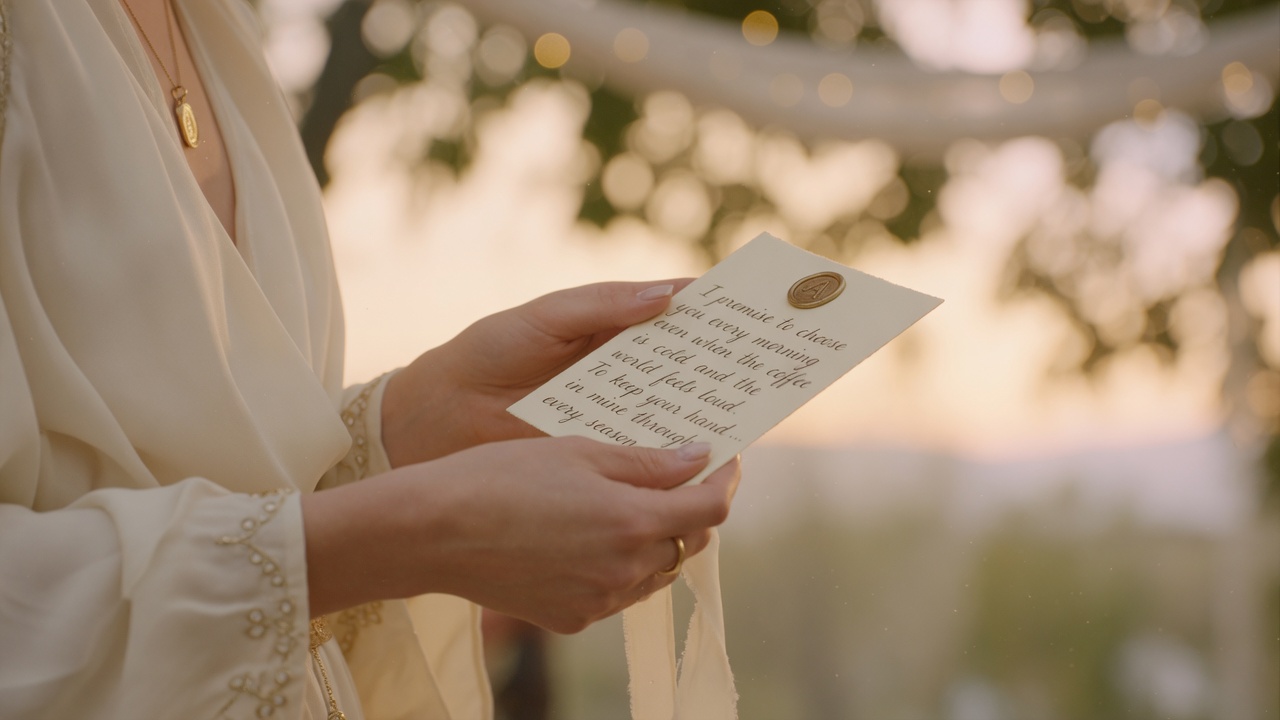
- Practice standing, holding the card the way you will at the ceremony.
- Record one take on your phone and fix only the lines you rush or mumble.
- Do one full run with a trusted friend or alone in front of a mirror the day before — then stop rewriting.
Aim for a total spoken length of about one to two minutes unless you and your partner agreed otherwise. If you keep adding adjectives, cut them. Verbs carry better in open air: choose, listen, stay, celebrate, forgive.
When the content still feels generic, tighten the personal middle using ideas from custom personal vows, then freeze the draft. Practice is for delivery, not for reinventing the vow the night before.
Pace, Eye Contact, and What to Do With Your Hands
Most people speak 20–30% faster than they think they do when they are nervous. Deliberately slow down. Leave a half-second of air after each sentence. Your partner and the people in the back row both need that space.
Eye contact works best in a simple pattern: look at your partner for the opening line, glance down to find the next sentence, look up for the promise, and finish on their face. You do not need to stare without blinking. You need a few clear moments of connection so it does not feel like a speech to the lawn.
Hands are easier when they have a job. Hold a card, a small booklet, or each other’s hands if your officiant cues it. Avoid jingling rings, fixing hair mid-vow, or folding arms. If you tend to gesture widely, plant your feet and keep elbows soft near your ribs so the microphone stays with you.
If you are using a mic, ask the coordinator where to hold it and do one sound-check line in the same volume you will use for the real vow. Whispering into a mic is still hard to hear outdoors; shouting past it can clip. Match the volume you used in practice.
If You Cry, Freeze, or Forget a Line
Emotion mid-vow is not a failure. Plan for it the way you plan for weather. Pause, breathe in through the nose, swallow, and continue from the next full sentence — not from the half-word that broke. Guests will wait. Your partner already knows why it hit.
If you freeze, look at the card. That is what it is for. Skip the lost phrase and pick up at the next clear promise. Do not apologize at length; a soft smile and the next line is enough. If your voice disappears, take a sip of water if it is nearby, or simply stand still for three seconds. Silence feels longer to you than to anyone watching.
Backup options that remove shame from the moment: a large-print card in your pocket, a copy with the officiant, or a discreet reader device you have already practiced with. The point is continuity of meaning, not a perfect performance. Your vows can still be deeply personal even if a tear stains the margin.
Couples who want classic ceremony language sometimes find traditional forms easier to recover mid-emotion because the cadence is familiar — if that is your style, keep a clean copy of traditional wedding vows nearby as a safety net, or stick to your personal draft and accept a few imperfect breaths.
Ceremony-Day Checklist for Saying Your Vows
The day itself should not introduce new systems. Keep the plan boring and physical.
- Final printed copy in large type (and a backup with someone you trust)
- One full read-through that morning — not five nervous rewrites
- Water nearby; light food earlier so you are not shaky from caffeine alone
- Breath mark: shoulders down, feet planted, one slow inhale before you start
- Agree with your partner who goes first and whether you face each other or the guests
- Tell the officiant if you want a prompt, a pause cue, or help if you go blank
When it is your turn, start with the first line you practiced — not a new intro you invent under pressure. End on the promise you mean most, even if you skip a middle detail. How to say your wedding vows well is less about perfect recall and more about a clear choice spoken at a human pace.
If you want a related angle next, read more about wedding vows to say to each other: mutual examples for additional examples and ceremony-ready language.
If you want a related angle next, read this guide on humorous wedding vows: witty examples that still mean it for additional examples and ceremony-ready language.
Couples often continue with this guide on simple 3 sentence wedding vows examples for low-key days after drafting their core promises.
Frequently Asked Questions
Should I memorize my wedding vows or read them?
Either is fine. Most people do best with a blend: memorize the opening and closing, and read the personal middle from a card. Guests care that you mean the words, not that you performed from pure memory. Always keep a backup copy nearby in case nerves wipe a line.
How long should it take to say wedding vows out loud?
About one to two minutes when read slowly is a comfortable range for most ceremonies. Agree on length with your partner and officiant. Shorter is better than rushing a long draft. Practice with a timer once so you know how your pace really feels.
What if I cry while saying my vows?
Pause, breathe, and continue from the next full sentence. Crying is common and usually lands as sincere, not awkward. Do not apologize at length. Have large-print text ready so you can find your place without starting over from the beginning.
How many times should I practice saying my vows?
A daily out-loud read for several days, plus one standing rehearsal and one run with another person in the room, is enough for most couples. Stop heavy rewriting two days before the ceremony so practice locks the final version, not a moving draft.