Knowing what to do with your hands when reading vows sounds minor until you are standing under the arbor and your fingers suddenly have nowhere to go. Hands that fidget, clutch, or vanish into pockets pull attention away from the promise — and they make you feel more nervous than you already are.
This guide gives your hands a simple job: hold something steady, rest without locking up, and stay free enough for one or two natural gestures. Pair it with broader delivery advice in how to say your wedding vows. If the wording is still unfinished, lock it first with how to write wedding vows, then practice posture and hands with the final text only.
Why Your Hands Matter When You Read Your Vows
Guests watch faces first — but hands sit in the same frame. Shaking paper, twisting a ring, folding arms, or gripping a phone like a steering wheel reads as tension even when your voice is warm. Calm hands make the whole moment feel intentional.
Your body also follows your hands. When fingers have a clear task (holding a card at chest height), shoulders drop and breath steadies. When hands search for something to do, your pace often speeds up and eye contact shrinks. That is why answering what to do with your hands when reading vows is part of delivery practice, not vanity.
Shorter vows help here too. Less paper, less scrolling, less time for fidget habits to start. If your draft still sprawls, trim using rhythm ideas from short and meaningful vows before you over-rehearse a long card.
The Best Default: Give Your Hands a Job
Idle hands invent problems. The simplest fix is a single, rehearsed job for both hands — or one hand holding and one resting — from the first line to the last.
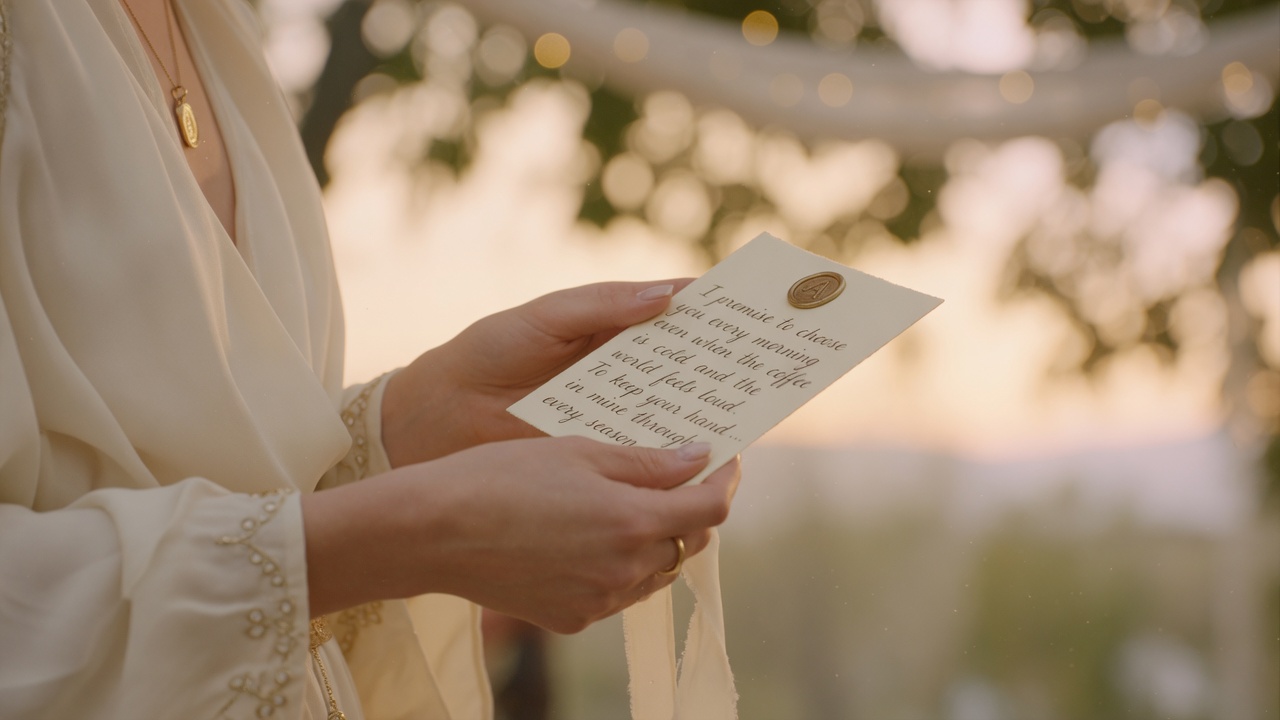
- Two hands on a stiff card or small booklet — best default for most people; elbows soft near your ribs
- One hand on a card, one lightly at your side — works if the card is small and type is large
- Phone or tablet at chest height — both hands or one firm grip plus a soft second hand; only if you practiced that exact device
- Partner’s hands — only when your officiant cues it or you agreed to hold during vows; do not improvise mid-line
Pick one setup and use it in every out-loud rehearsal. Ceremony day is not the time to try a new folder, ring box, or microphone stand. For line-by-line reading without dense paragraphs, many couples prefer a wedding vow teleprompter held the same way each practice — large type, slow scroll, Do Not Disturb on.
Whatever you hold, keep it at mid-chest, not at your waist and not covering your face. That height keeps type readable and leaves your eyes free to meet your partner between sentences.
Holding Cards, Booklets, and Phones Without Looking Stiff
Paper and screens both work. Stiffness comes from high shoulders, locked elbows, and white-knuckle grips — not from the prop itself.
Print large type on a stiff card so you are not pinching floppy sheets in the wind. Hold the edges lightly; press thumbs gently on the front so the card does not flap. If you use a small booklet, open it before you start speaking so you are not wrestling a cover mid-vow. For a phone, silence notifications, raise brightness ahead of time, and angle the screen slightly down to cut glare outdoors.
"I choose you today with a clear mind and a full heart. I promise to listen when it is hard, celebrate when it is easy, and keep building a life that feels like home with you."
Practice that length standing up, holding the real card or device. Silent couch practice does not train grip or height. If you plan to memorize most of the text, still rehearse with a blank card the same size so your hands know the posture — then keep a full backup nearby as described in how to memorize your wedding vows.
Avoid stacking props: card plus loose tissues plus phone plus bouquet. One primary object. Pocket the rest or hand them off before your turn.
Holding Hands With Your Partner
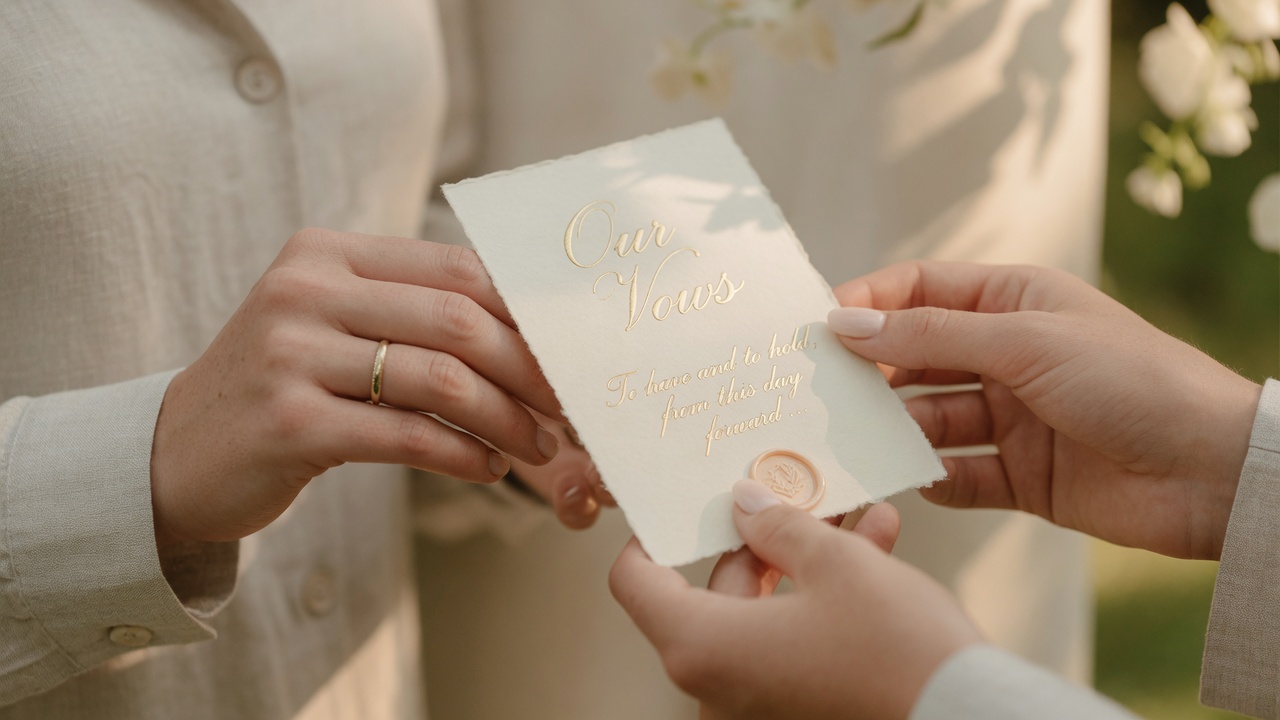
Holding hands during vows looks intimate when it is planned. It looks awkward when one of you still needs two hands for a dense page. Decide ahead of time with your partner and officiant.
Good patterns: hold both hands for the opening line, then release so one person can lift a card; or keep one hand joined and one free for notes; or hold only during the final promise after both of you have finished reading. Bad patterns: grabbing mid-sentence, yanking a microphone cable, or forcing a grip while your partner is still turning a page.
If you cry easily, a steady hand-hold can ground you — but only if it does not block the text. Large type and a short draft make one-handed reading possible. Agree who goes first and whether you face each other fully; facing in usually makes hand contact feel natural without turning your backs to guests.
Tell the photographer you may hold hands so they do not stage a different pose during the vow itself. The promise is the moment. Hands are support, not a second performance.
Gestures That Help vs Habits That Distract
A little movement reads as human. Constant motion reads as nerves. Use a simple rule: gesture on meaning, then return home.
Helpful: a soft open palm toward your partner on a key promise; a brief smile and glance up after a line; a small nod when you finish. These are slow and rare — one or two in a one-minute vow is plenty.
Distracting: twisting a ring, fixing hair or a veil mid-sentence, jingling jewelry, pointing at guests, folding arms, putting hands in pockets, or flipping the card every three words. Also avoid using the card as a fan or a shield in front of your chest.
If you tend to talk with big arms, plant your feet hip-width apart and keep elbows soft near your ribs so any gesture stays small. Microphones punish wide swings: a handheld drifts off axis; a lapel still wants a still torso. Do one sound-check line at practice volume with the same hand position you will use on the day.
When a personal middle still feels generic while you rehearse, tighten the story using patterns from vows drawn from your story, freeze the draft, and only then drill hands and delivery — not both at once.
A Simple Ceremony-Day Hand Plan
The day should introduce no new systems. Keep the plan boring and physical.
- Final large-print card or loaded device — same setup you practiced all week
- Backup copy with the officiant or a trusted person
- Empty pockets of keys, loose change, and anything that rattles
- Shoulders down, feet planted, card at chest height before you speak
- One slow inhale; start with the first line you rehearsed — not a new intro
- Between sentences: glance down, find the next line, look up for the promise
- If emotion hits: pause, keep the card still, breathe, continue from the next full sentence
"You are my favorite person and my safest place. I vow to love you with patience, humor, and honesty — today, and in every ordinary day we get."
End with both hands still and eyes on your partner. That quiet finish often lands harder than a flourish. What to do with your hands when reading vows, in the end, is less about etiquette and more about removing friction so the words can do their job.
For more inspiration on this topic, explore our guide to Wedding Vow Structure for Heartfelt Ceremonies — with examples, structure tips, and wording you can adapt for your ceremony.
Frequently Asked Questions
What should I do with my hands when reading wedding vows?
Give them one clear job: hold a stiff card, small booklet, or phone at mid-chest with soft elbows. Avoid pockets, folded arms, and constant ring-twisting. Practice that exact hold out loud so ceremony day feels familiar.
Should I hold my partner’s hands while saying vows?
Only if you planned it. Holding hands looks warm when both of you can still read comfortably. Many couples join hands for the opening or closing only, then free a hand for the card. Agree with your partner and officiant ahead of time.
Is it okay to read vows from a phone?
Yes, if you practice with that phone: large type, high brightness, Do Not Disturb, and a stable two-hand or firm one-hand grip at chest height. Keep a paper backup in case of glare, battery, or software issues.
How do I stop my hands from shaking when I read vows?
A light, intentional grip on a card often steadies you more than empty hands. Plant your feet, drop your shoulders, and slow your breath before the first line. Slight shaking is normal and rarely as visible as it feels. Do not white-knuckle the paper.
Where should I hold my vow card?
About mid-chest height — high enough to read without hunching, low enough that it does not hide your face. Keep elbows soft near your ribs so microphones and photos stay clean.
Can I gesture while reading my vows?
Yes, sparingly. One soft gesture toward your partner on a key promise is enough. Return your hands to the card afterward. Big or constant motion pulls focus and can move a handheld mic off axis.